
Writing Action

11021463_1606585152905993_2451883923961004161_o

Just over a week ago, on a sunny afternoon, I was skiing with a friend, about to make the last descent of the day. We’d already had a great afternoon bombing down the mountain, chasing that feeling of exhilaration and grace that comes from a special combination of speed, frictionless motion, and the raw beauty of snow, trees, mountains and sky. I wasn’t tired, sore, or distracted. Yet…

From the chairlift we skated over to the top of a trail I’d been on many times before, one of my favorites– it’s narrow and winds back and forth through the trees, and takes you all the way to the base lodge. I wasn’t quite ready, but without looking or thinking I crested the lip of the trail and started down a steep, mogul-strewn drop that ordinarily takes just a few seconds to ski through before leveling off a bit.

This time it took me longer. Unprepared for the icy moguls, my ski caught and I fell forward, hard. Falling is part of skiing– it shows us the limits of our equipment, the terrain, and our ability, and I usually do it at least once every time out. This fall was different. While my body plummeted forward, my leg, stuck in the ski and rigid boot, stayed in its natural position. My ski popped off, and my freed leg swung around to join the rest of me; but in doing so, everything changed. Almost in slow motion my knee pivoted forward, and I felt something inside it twist and tear just a little too far. I slid a bit further and came to a stop halfway down the steep pitch. I pictured jumping up and walking uphill to grab my ski, and, with a bit more caution, finishing the run. If it were a warm, spring day, we might have wrapped up the afternoon with a beer on a sunny deck. But I knew instinctively that I could not go get my ski, that I likely could not walk at all. As adrenaline and endorphins rushed to my leg, making it feel happy and warm, I realized that something was seriously wrong.

As humans, we seem to be captivated by action, by violence. Perhaps this is a survival instinct of sorts– it is, after all, an active and violent world at times, and we revere those strong, steadfast individuals and institutions that protect us by relentlessly crushing our enemies. This fascination can be seen in many elements of culture, from actual war, to sports, to the movies, TV shows, books, and plays that inform our sense of social identity. I love football because of the athleticism, the adrenaline rush from a well-executed play, the high stakes drama of winning or losing, and above all the chess-like strategizing behind each move and countermove. But another draw that helps make it the most popular sport in America is the hits– the collisions, tackles and sacks that bring a guilty thrill of pleasure, an appreciation of one huge athlete laying out another with power and skill.

In fiction, violence is often noble and heroic. Despite his town abandoning him, in High Noon Gary Cooper stays to fight the outlaws, and we love him for his steadfastness and sacrifice. These days, we apparently can’t get enough of super heroes who single-handedly save our city, world, or universe by beating the shit out of the bad guys. Other times, violence is inconsequential, beautiful, and comic, as in Looney Tunes, or as in Quentin Tarantino and the generation of filmmakers he inspired. Yet the story violence that is most true to life occurs in tragedy, because it has real consequences beyond saving the day or titillating the audience. Macbeth and his wife kill their king out of base ambition; Agamemnon sacrifices his daughter to get a favorable breeze; Stringer Bell betrays Avon Barksdale by having D’Angelo killed; and in turn each of these tragic heroes must pay the ultimate price for their actions.

These stories tell the truth– that violence always has far-reaching consequences. The football player who takes hit after hit may end up with dementia in his 40s; he may die of an overdose, or by suicide, because he simply can’t live with the pain. Endless war in Africa or the Middle East is self-perpetuating, and its roots can go back dozens, hundreds, or thousands of years. Even the smallest event has long lasting effects: falling on a ski slope and tearing your ACL can be portrayed as a vivid instance of drama, but the real story is the week of lying in bed, the hobbling around on crutches, the premature end of the ski season, the necessary surgery and six month recovery. Or perhaps it’s about being thankful that nothing worse occurred, or the relief of finally having healthcare after 15 years without it; or the simultaneous worry over the high deductible, having chosen the cheapest plan based on the belief that getting ill or injured is unlikely. Whatever this story is about, I guess sometimes we need a reminder– as writers, as consumers of culture, as actors in society– that the shiny, transfixing moment of action is indeed only one moment, yet its repercussions will linger long after most people have forgotten it.

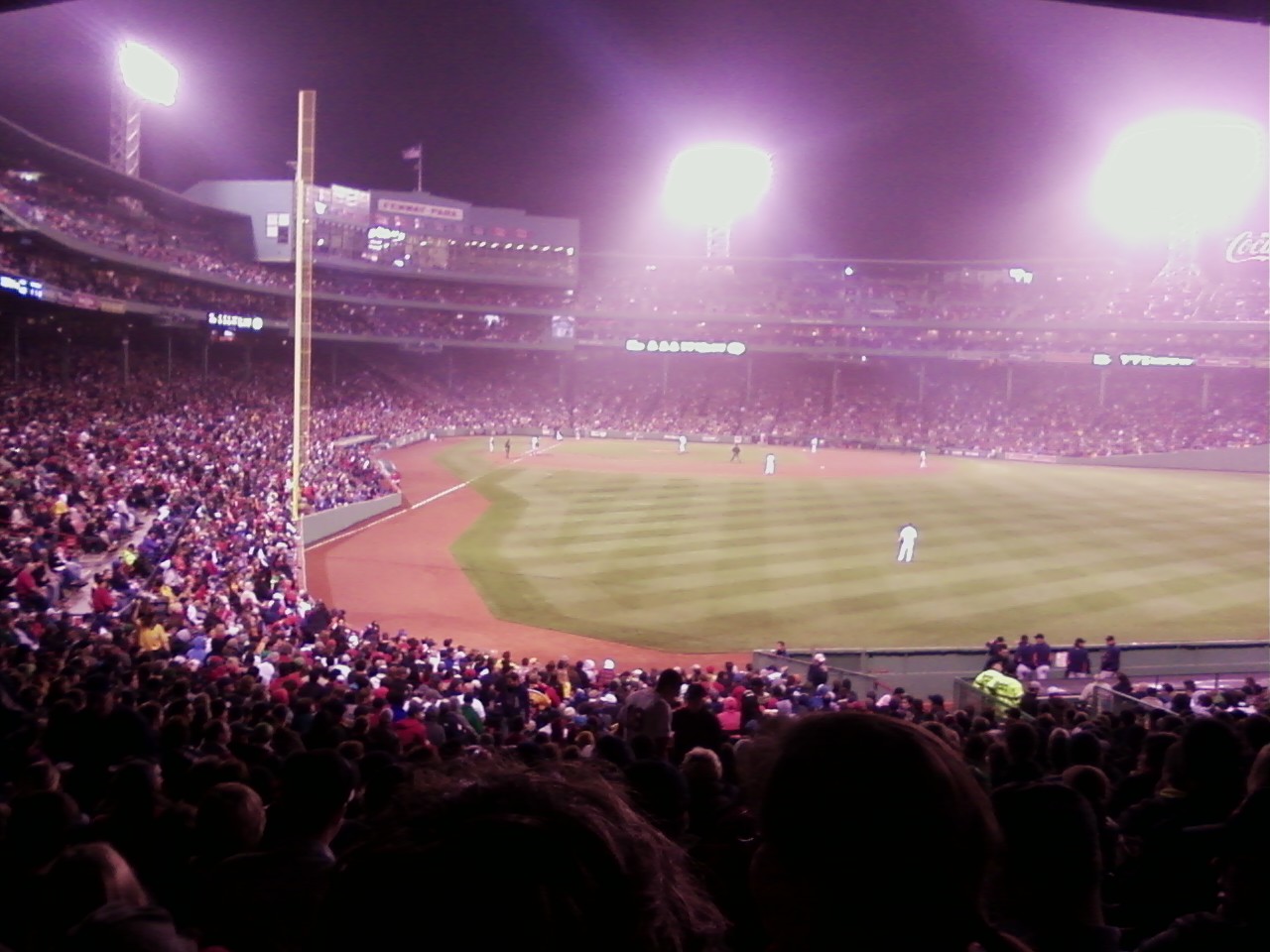
At 2 hours or 3 hours, baseball is a slow, dull, glorious game.

0520001805

You may have heard that Major League Baseball is implementing new rules to speed up the pace of games. So far, these include common sense ideas like making sure between-inning commercials don’t run long, and preventing the batter from getting out of the box between every pitch to adjust his gloves (except for a hundred or so exceptions– after a swing, when timeout is called, after a bunt attempt, and so on). There is talk of more stringent rules to follow– a clock that counts down the time allowed for the pitcher to throw, limiting catcher/coach visits to the mound, automatic intentional walks, and even having pinch runners for catchers, the tortoises of baseball. The idea behind all these changes is that baseball games are too long (just over 3 hours on average); this is bad because young people supposedly don’t have the attention span to last that long before they disappear into the interwebs, or whatever it is that the youth do these days. I wonder, though, if the complaint is as much for older generations, who lament the fact that things are different now from the way they used to be.

I’m not sure if I’ve actually heard anyone say “Back in my day…” when talking about the length of baseball games, but that sentiment shines through in columns by and conversations with fans of a certain age. In the early 80s, the average length of a game was about 2 and a half hours, and the people who complain the most and loudest about how many pitches are fouled off, or how many times the catcher runs out to yell at his pitcher, are those who came of age in that era or earlier. This is what I think of as the conservative instinct, which is hardwired into all of us ever since we were kicked out of Eden, or since Pandora opened her box: life in the past usually trumps the sorry state of the fallen present. Yet we have to remember that a lot of times things are simply different, and sometimes better, than in the past, and they will be different again (and hopefully better) every single day and year and century to follow.

It’s easy to find cases of progress over time, rather than regression. Go back to 1959, when my Boston Red Sox were the last team to integrate, 12 years after Jackie Robinson became a Dodger. As many have written, was the 86-year World Series drought really the Curse of the Bambino, or was it caused by the scourge of Yawkey (and institutional) racism that persisted at least into the 90s http://www.bostonglobe.com/sports/2014/09/20/tommy-harper-still-haunted-time-with-red-sox/Tw0RLaFinaqTqkt8jLsYeP/story.html? Although racism, sexism, and homophobia continue to be huge negative influences on sports and society, who wouldn’t say that things are much, much better now than they used to be?

Which brings us back to the length of baseball games, quite a trivial matter in comparison. But the facile point, that traditional doesn’t necessarily mean better, might apply in this case as well: why can’t longer games be considered an improvement? Personally, I love baseball. I love the slow build, the drama, the strategy (and meaningless ritual) that goes into every at bat, every throw to first, every foul ball, every taken pitch, every practice swing and batting glove adjustment (I wish Clay Buchholz would throw his pitches a bit quicker, but what are you going to do). I love the fact that it’s so slow you don’t always have to pay attention; I can keep one eye (or ear– I usually listen on the radio) on the game while cooking, reading, gardening– even working. I love the goofy interplay between Joe and Dave or Don and Remy. I love how the crawling pace and even dullness of baseball sets up intense moments of overwhelming excitement– Ellsbury stealing home, Pedey making an amazing, run-saving catch, Papi hitting a grand slam to tie the game late, with Torii Hunter tumbling into the bullpen. It’s a contrast so dynamic that I believe it exceeds the action sequences of any other sport. So why would I want there to be less of it?

0519012105

People complain especially about the length of Red Sox/Yankee games, which can stretch to 4 hours with all the patient hitters taking pitches and hitting foul balls. For me these are the most exciting games of the year– the Rivalry™ that is overly hyped, and which has grown a bit stale in recent seasons, still has the power to make for thrilling entertainment; and until recently, the battles were long and epic because both teams were so good, and evenly matched. In my memory, the Sox’s games last year seemed to include a lot of hasty, under 3 hour affairs; and the team–especially the free swinging offense– was dreadful, flirting with and finally settling comfortably into last place. The good Red Sox teams of the 21st century have succeeded specifically because they walked, fouled, and drove up pitch counts; and they never would have won the last two World Series without “painfully” slow pitchers like Jon Lester and Josh Beckett. At least on the hitting side, the longer games are due in large part to awareness of the value of on base percentage, and of patient, disciplined at bats.

But again, what about the youth? While MLB viewership is going up, the average age of baseball fans is also steadily increasing, and according to the Wall Street Journal, kids ages 6-17 make up just 4.3% of audiences. In my unscientific analysis of my freshman writing students, the majority don’t watch any professional sports at all (as I didn’t in high school or college– I had much more important things on my mind in those days, like figuring out what life was all about.) Among the sports fans, more do seem to like baseball the best, but that could be geographic or simply idiosyncratic. I wonder, though, will shortening baseball games– which still take less time than the average (insanely popular) football game– make any difference in attracting younger fans?

Baseball is a game of potential and possibility, the only game that specifically and intentionally has no time limit. It’s perfect for people who are patient, determined, and romantic. Some people need the constant action of the back and forth on the court, rink, or pitch; many more just don’t get why anyone cares about the outcome of a meaningless game athletes make way too much money to play; and some few of all ages find beauty, value, and wonder in the repetitive, mostly boring battle between a guy throwing a ball and another one hitting that ball with a wooden stick at some other guys (or better yet, where those other guys ain’t). There’s around a 65% chance or higher that my favorite hitter will make an out; but what if this is one of those rare times when he gets on base? What if he hits a home run to win the game? Those 3 blessed hours of hoping and dreaming and washing dishes and surfing the interweb will have paid off, and I wouldn’t want it to go by any quicker.

0510001640